
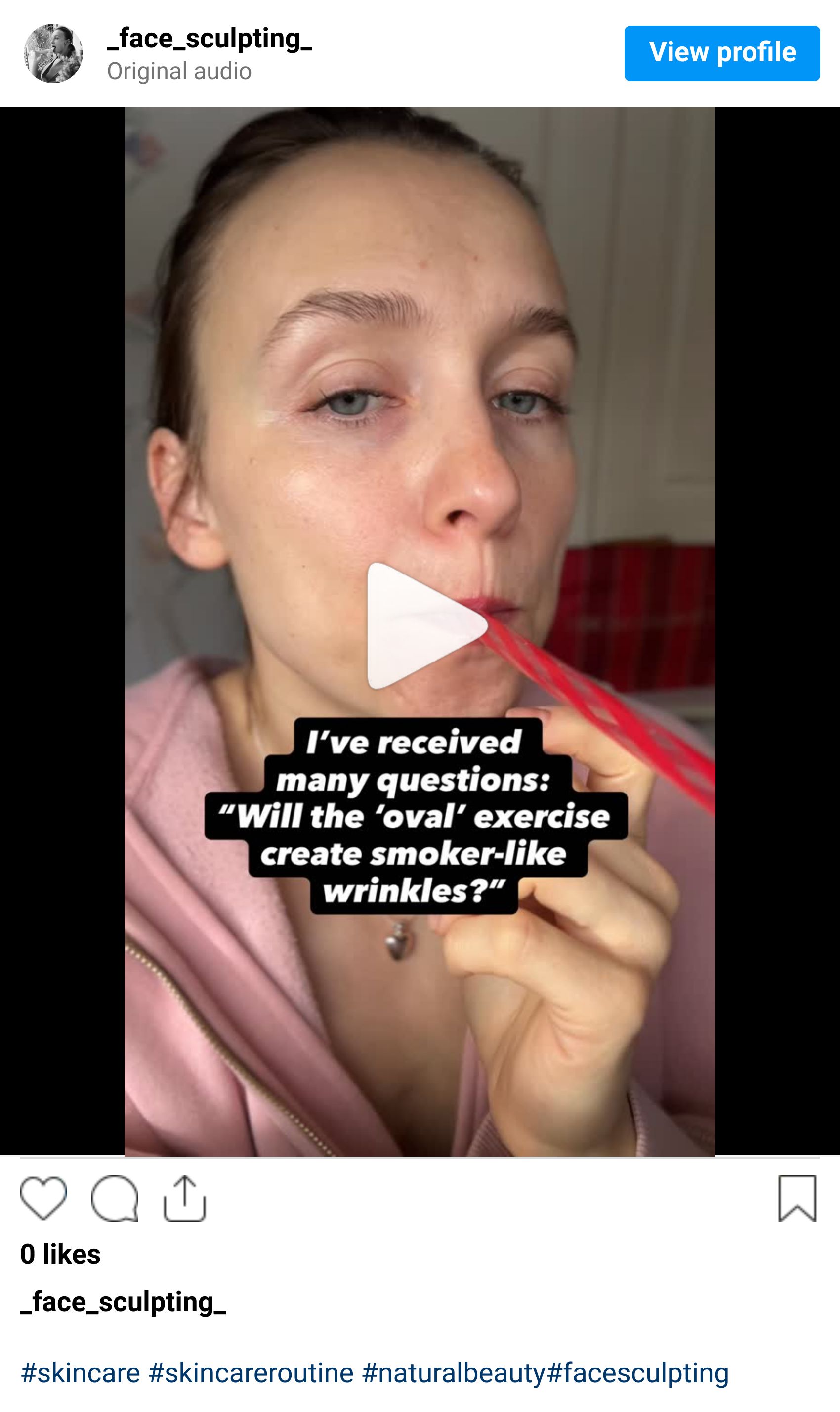
I’ve received many questions about the purse-string muscles around the mouth and whether the “oval” and “oval + smile” exercises can cause smoker-like wrinkles.
Answer:
The movement of the lips during smoking is very different from the movement in the “oval” exercise.
During smoking, the lips are statically pressed together, and the orbicularis oris muscle is simply in a tense, spastic state.
In the “oval” exercise, this muscle works in a functional mode: it simultaneously contracts and stretches under control, which improves blood circulation, reduces spasm, and restores normal muscle tone.
But the main factors causing purse-string wrinkles in smokers are:
Nicotine — the main factor: it causes blood vessel constriction, reduces skin blood flow, limits oxygen and nutrient delivery, breaks down collagen, and slows its production
As a result, the skin thins faster, loses elasticity, and its ability to regenerate declines
Important: even if someone smoked without puckering their lips, wrinkles would still form due to the systemic effects of nicotine and reduced skin quality
Age-related decline in collagen and elastin production
Photoaging: ultraviolet radiation breaks down collagen fibers, making the skin thinner and less firm
Hormonal changes: decreased estrogen worsens skin quality, reducing density and regenerative capacity
Impaired microcirculation and tissue nutrition
Skin dehydration
When you perform the “oval” and “oval + smile” exercises (stretching the lips into an oval while activating a smile), the orbicularis oris receives not static tension, but a controlled functional load:
alternating stretching and contraction
eccentric load (the muscle lengthens under control)
improved blood and lymph circulation
restoration of normal muscle tone (reducing over-tension or weakness)
Result:
These exercises do not create purse-string wrinkles. Regular practice, on the contrary, helps restore normal muscle tone, improves tissue nutrition, and reduces the appearance of age-related changes.